Excavator Rental - Bobcat E55 Compact 12,000#, 6 Tons
The Bobcat E55 Compact Excavator brings 12,000 lbs and 6 tons of digging capability to mid-size excavation work — enough machine to handle serious foundation cuts, deep utility runs, and commercial site prep while still fitting on a standard lowboy without a permit load. NorthPoint Equipment Rentals keeps the E55 available across all five New Hampshire locations, including the Tilton hub serving the Lakes Region, so contractors and municipalities can get it on-site fast without coordinating a long-haul delivery.
Features





Description
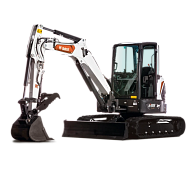
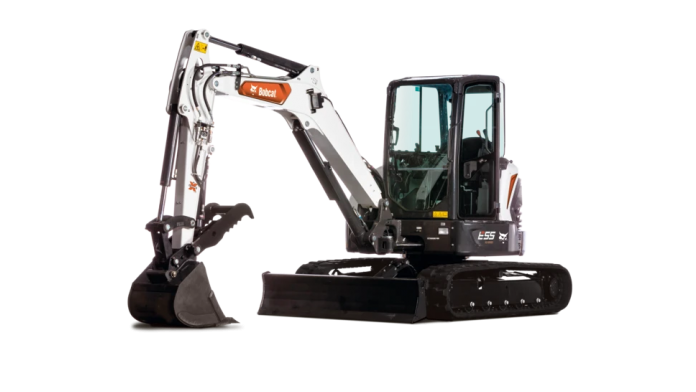
The Bobcat E55 Compact Excavator sits at the upper edge of the compact class — 12,000 lbs, 6 tons, and built to handle the kind of work that a mini excavator will struggle with but doesn't require a full-size machine to complete. That's a useful place to be. It digs deeper, lifts more, and pushes through tougher material than anything in the 2- to 4-ton range, but it still moves on a standard lowboy trailer without triggering oversize permit requirements, and it fits on job sites where a 20,000 lb machine would cause problems with ground conditions or access.
Bobcat engineered the E55 with a diesel engine producing enough hydraulic flow to run demanding attachments without bogging — hydraulic breakers, augers, and hydraulic thumbs all work off the auxiliary circuit without modification. The boom and arm geometry gives the machine a dig depth in the range of 11 to 12 ft, which covers the full range of residential utility work, most commercial foundation requirements, and the kind of deep drainage installs that come up regularly on NH sites where frost penetration mandates burial depths well below 4 ft. The zero house swing option on the E55 keeps the counterweight within the track footprint during rotation, which matters on constricted commercial lots and municipal right-of-way work where swinging into adjacent structures or traffic isn't an option.
The operator station is a full cab — climate controlled, with heat and air conditioning, good sightlines to the bucket, and enough sound attenuation to work a full shift without fatigue. The controls are pilot-hydraulic and laid out consistently with the broader Bobcat line, so operators who've run smaller Bobcat excavators will be productive quickly. The E55 also runs Bobcat's selectable work modes, which let the operator dial back hydraulic flow for precise finish work — grading, shaping, cleanup — and open it up for heavy production digging. That flexibility is worth something on a job that moves through multiple phases in a single day.
The contractors renting the E55 at our New Hampshire locations are typically doing work that a mini excavator won't finish efficiently: foundation excavation on new construction, commercial utility installation, culvert replacement, and land clearing on sites where stumps and root systems need real pulling power. Municipalities around the Lakes Region and North Country rent it for road drainage work, catch basin repair, and culvert projects where the excavation depth and material density exceed what lighter machines can handle. Landscaping contractors use it for larger pond installs, significant regrading, and boulder work. The E55 is capable enough to be the primary machine on a mid-size commercial job and nimble enough to still be useful on a residential lot with reasonable access.
In central and northern New Hampshire, you'll encounter glacial till, granite ledge, and compacted gravel subbase — the E55 handles all of it at normal digging conditions. For confirmed ledge, the auxiliary hydraulics support a hydraulic breaker, and we carry compatible breaker attachments at several locations — call ahead and we'll have it staged. For general excavator and backhoe rental across New Hampshire, the E55 is the right step up when the job has outgrown the mini class but doesn't warrant a full-size machine.
A few operational notes before you take delivery: diesel only, and at this operating weight the E55 moves on a lowboy — confirm your trailer's rated capacity before you load it. Ground conditions matter more at 6 tons than they do with a mini; if your site has soft spring ground or unstable fill, talk to our counter staff before booking. Rubber tracks are standard and will protect finished surfaces, but they still leave impressions on saturated soil. The auxiliary couplers are at the arm; your rep will walk you through the connection before you leave the yard. If the job involves compaction after excavation, we can set you up with a plate compactor or jumping jack from our compaction equipment lineup at the same time. Our best price guarantee applies across all five locations, and contractors doing regular work in New Hampshire should look at a charge account — it keeps billing clean on multi-day and multi-machine jobs. Not sure if the E55 is the right size or whether you need to step up to a larger machine? Call us — our staff works with contractors on NH job sites every day and will give you a straight answer.
What the E55 Brings to the Job
Serious Digging Depth The E55 reaches approximately 11 to 12 ft of maximum dig depth, which covers the full range of residential utility work, commercial foundation requirements, and deep drainage installs. That's meaningfully more capability than the mini class and handles the depth requirements that come up regularly on New Hampshire sites with a 4 ft frost line.
Full Climate-Controlled Cab Heat and air conditioning in a sealed operator cab means the E55 is comfortable to run year-round — mud season, peak summer, late-season drainage jobs. Sightlines to the bucket are solid, sound attenuation cuts shift fatigue, and the overall environment lets an operator stay focused and productive through a full day.
Selectable Work Modes The E55's work modes let the operator dial hydraulic flow down for precision finish grading and open it back up for heavy production digging — without leaving the seat. That flexibility matters on jobs that move through excavation, shaping, and cleanup phases in a single day on the same machine.
Auxiliary Hydraulics Full auxiliary hydraulic flow at the arm supports breakers, augers, hydraulic thumbs, and other attachments without modification. The E55 has enough hydraulic output to run demanding attachments effectively — a hydraulic breaker on this machine actually works; it's not undersized for the tool.
Zero House Swing The counterweight stays within the track footprint during rotation, keeping the machine usable on constricted commercial lots, municipal right-of-way jobs, and any site where swinging into adjacent structures or traffic lanes is a real concern. At 6 tons, that matters more than it does on a mini.
Lowboy-Transportable At 12,000 lbs, the E55 moves on a standard lowboy trailer without triggering oversize load permit requirements on New Hampshire roads. It's heavier than a mini, but the logistics are still manageable — no specialized haul truck, no permit coordination for a typical job site move.
Specifications
| Specification | Value |
|---|---|
| Weight & Dimensions | |
| Operating Weight | ~12,000 lbs |
| Tons | ~6 tons |
| House Swing | Zero house swing |
| Track Type | Rubber tracks |
| Performance | |
| Maximum Dig Depth | ~11–12 ft |
| Cab Type | Enclosed — heat & A/C |
| Work Modes | Selectable hydraulic flow modes |
| Auxiliary Hydraulics | Yes — standard at arm end |
| Power & Fuel | |
| Fuel Type | Diesel |
The E55 requires a lowboy trailer rated for its 12,000 lb operating weight — confirm your trailer capacity before loading. No CDL is required for haul at this weight class on a properly rated trailer, but oversize permit requirements should be verified for your specific rig configuration. Rubber tracks are standard.
What It Gets Used For
- Foundation excavation on new residential and light commercial construction
- Deep utility installation — water, sewer, and electrical runs requiring 6 ft or more of depth
- Culvert replacement and road drainage work for municipalities and contractors
- Land clearing with stump and root system extraction on larger sites
- Commercial site prep — rough grading, cut and fill, material relocation
- Boulder and ledge work with hydraulic breaker attachment
Questions Renters Actually Ask
What trailer do I need to haul the Bobcat E55, and do I need a CDL? The Bobcat E55 weighs approximately 12,000 lbs operating weight, so you'll need a lowboy trailer with a rated capacity at or above that — a standard bumper-pull equipment trailer in the 14,000 lb GVW range with proper ramps will handle it. CDL requirements depend on the combined gross weight of your tow vehicle and trailer, not the machine alone; if your rig combination exceeds 26,000 lbs GCWR, a CDL is required. If you're unsure where your setup lands, call us before you show up — we'd rather sort that out on the phone.
How does the E55 compare to the E20 — when does it make sense to step up? The step from the E20 to the E55 makes sense when dig depth, pull force, or material density is the limiting factor. The E55 reaches approximately 11 to 12 ft versus the E20's 8.5 ft, and it pushes through compacted gravel, heavy clay, and root-dense soil that will slow a mini to a crawl. If you're doing a straightforward residential trench on clean soil under 8 ft, the E20 is the right call — it's easier to haul and costs less per day. If you're cutting a foundation, hitting dense material, or running a hydraulic breaker for any meaningful amount of time, the E55 is the machine.
Can the E55 run a hydraulic breaker, and do you carry compatible breakers? Yes — the E55 has enough auxiliary hydraulic flow to run a breaker effectively, and we carry compatible hydraulic breaker attachments at several NorthPoint locations. The key word is effectively: at 6 tons, the machine has the weight and stability to back the breaker up, unlike a mini that can get pushed around by breaker recoil on hard material. Call ahead before your rental date and we'll confirm availability and have the attachment staged at your pickup location.
Other products
Browse some of our other products
Excavator Rentals
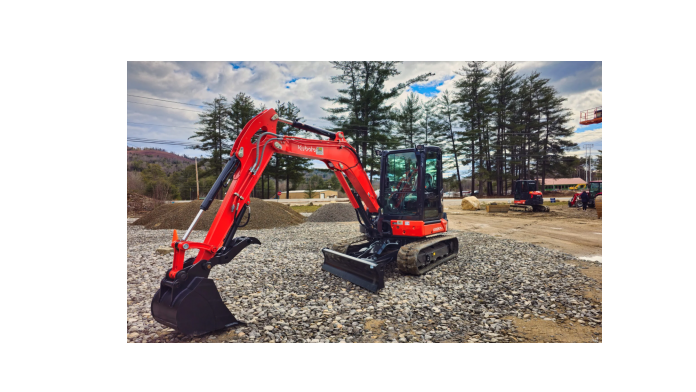
Excavator Rental - Kubota KX-057-5 ONR 13,106#, 6.55 Tons
from $ 425.00 per day
- 13,106 lbs | 6.55 Tons | 47.6 HP | 19.3 Gallons
Excavator Rentals
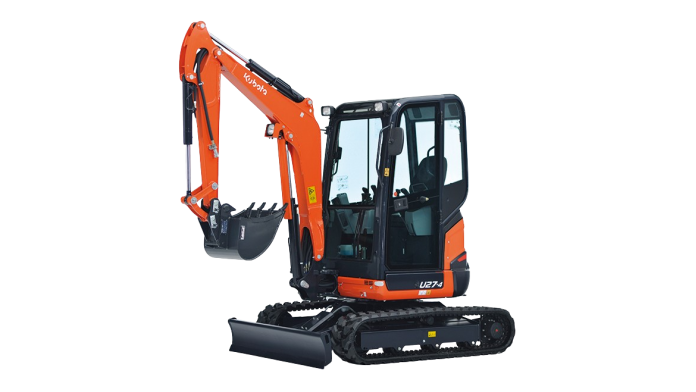
Excavator Rental - Kubota U35-4 Compact Excavator 8,996#, 4.5 Tons
from $ 375.00 per day
- 8,996 lbs | 4.5 Tons | 23.3 HP | 12.4 Gallons